
ISPGR was delighted to award Dr Benjamin Filtjens its 2025 Emerging Scientist Award (ESA). In his ESA Plenary Talk at the 2025 World Congress in Maastricht, Netherlands, Dr Filtjens shared how artificial intelligence (AI) and wearable sensors are helping tackle one of the most challenging symptoms of Parkinson’s disease: walking difficulties and freezing of gait. This post summarizes the key points from this talk.
Walking difficulties are among the most disabling symptoms of Parkinson’s disease. Two important aspects of gait assessment in Parkinson’s are the severity of freezing of gait (FOG) and the overall gait severity rating. FOG refers to sudden episodes in which patients are unable to move forward despite intending to, while a global clinical impression of gait is measured using standardized rating scales such as the (MDS-)UPDRS. Traditionally, both are assessed visually by clinicians reviewing gait tasks or video recordings. While effective, this approach is time-consuming, subjective, and difficult to scale.
Artificial intelligence (AI) offers a promising way forward: Deep learning methods can automatically process wearable-sensor or video data to estimate FOG episodes or UPDRS gait scores. Yet, a persistent challenge in the field is cross-center generalization. Most AI models are trained on relatively small, single-center datasets, which limits their ability to handle the wide variability in patient gait patterns, clinical tasks, and sensor/video configurations. As a result, models that work well in one center often perform far less accurately when tested on data from another center (or a different group of patients).
Our two recent studies approached the generalization problem from complementary perspectives. The first examined how wearable-sensor–based deep learning models for FOG detection transfer across six independent cohorts, and whether we can improve transfer by means of FOG-IT, a web application that enables human–AI collaborative scoring of FOG episodes (Figure 1). In this workflow, the AI provides an initial prediction and the user can verify and correct it, keeping clinical expertise in the loop. The second examined how video-based deep learning models for UPDRS gait severity estimation transferred across four independent cohorts, and whether this could be improved using CARE-PD, the first open-source, multi-center 3D gait dataset with clinical labels.
In our studies, we found that models performed well when trained and tested on data from the same site, but their robustness dropped notably when applied to data from other centers. Study-specific metrics decreased by approximately 14% for FOG detection and 46% for gait-score estimation compared to within-site results. However, we could mitigate this drop by adapting the source-site–trained model using a small local sample from the target site. For FOG detection, an AI-assisted annotation workflow such as FOG-IT can make collecting such a local sample more feasible: the model first proposes FOG episodes and clinicians then correct these predictions, producing clinician-verified annotations that can be used to fine-tune (update) the model for the new center, while also providing oversight during deployment. These findings show that between-center differences reduce model robustness and strongly underline two needs: humans should remain involved in the scoring process to verify performance and enable safe, efficient local adaptation when a model is applied in a new setting (e.g., via FOG-IT, Figure 1), and the field needs multi-center development and validation datasets with standardized benchmarking to improve generalization (e.g., CARE-PD).
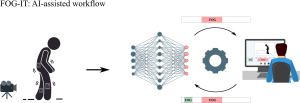
Figure 1. FOG-IT AI-assisted workflow. A deep-learning model generates initial annotations of FOG episodes in gait tasks. A human evaluator reviews and corrects these annotations and makes the final decision, thereby enabling correction of cross-center algorithmic biases.
FOG-IT (now called AID-FOG):
More information about the study—including a demo of the AI-assisted annotation platform and a link to the manuscript—is available on its webpage: https://aidfog.be/
Yang, P. K., Carlon, J., Goris, M., Klaver, E., Nonnekes, J., van Wezel, R. J., … & Filtjens, B. (2025). Deep Learning for Freezing of Gait Assessment using Inertial Measurement Units: A Multicentre Study. medRxiv, 2025-06; doi:https://doi.org/10.1101/2025.06.27.25330405.
CARE-PD:
More information about the study—including links to the benchmarking codebase, the multicentre dataset, and the manuscript—is available on its webpage: https://neurips2025.care-pd.ca/
Adeli, V., Klabucar, I., Rajabi, J., Filtjens, B., Mehraban, S., Wang, D., … & Taati, B. (2025). CARE-PD: A Multi-Site Anonymized Clinical Dataset for Parkinson’s Disease Gait Assessment. arXiv preprint arXiv:2510.04312.; doi: https://doi.org/10.48550/arXiv.2510.04312.
About the Author

Benjamin Filtjens

Babak Taati
Copyright
© 2021 by the author. Except as otherwise noted, the ISPGR blog, including its text and figures, is licensed under a Creative Commons Attribution-ShareAlike 4.0 International License. To view a copy of this license, visit https://creativecommons.org/licenses/by-sa/4.0/legalcode.
ISPGR blog (ISSN 2561-4703)
Are you interested in writing a blog post for the ISPGR website? If so, please email the ISGPR Secretariat with the following information:
- First and Last Name
- Institution/Affiliation
- Paper you will be referencing