
Falls are a major focus of posture and gait research. However, most falls research has focused on risk factors emerging in later life, such as muscle weakness, sensory decline and cognitive impairment. Far less attention has been paid to whether lifelong coordination difficulties may shape fall risk across the lifespan. Developmental Coordination Disorder (DCD), often known as dyspraxia, affects around 5–6% of children and frequently persists into adulthood. Characterised by difficulties in balance, motor planning and coordination, DCD represents a sizeable population in whom fall risk has rarely been examined directly. We therefore set out to determine whether falls in this group have been underestimated.
We conducted an international online survey of adults with DCD (mean age 36 ± 12 years), typically developing adults (mean age = 44 ± 15 years), as well as parents of children with and without DCD. Over 400 participants were asked how often they experienced a fall, in what contexts these falls occurred, and the consequences these had on their daily life. We found that adults with DCD were nine times more likely to fall at least once or twice a month compared with adults without DCD. Among children with the condition, more than half experienced falls at least once a week. These were not harmless stumbles: Participants reported injuries ranging from sprains and fractures, to concussions and knocked-out teeth, and more than a third of adults with DCD had broken a bone because of a fall. The psychological toll was equally significant. Many of the adults reported being afraid to walk alone or use stairs, and 72% of children and adults with DCD were highly concerned about falling. Respondents described avoiding social events, sport and everyday activities. Adults also expressed concern about how their balance difficulties might affect them as they age.
Despite these experiences, DCD is currently absent from major fall prevention guidelines. Public health messaging typically focuses on ageing or neurological disease, yet our findings show that coordination-related fall risk begins much earlier and can persist across the lifespan. For posture and gait researchers, this highlights an overlooked population in whom chronic motor vulnerability may shape long-term fall risk. Greater recognition of DCD could inform earlier identification of balance difficulties and more targeted intervention strategies. Falls linked to DCD are often dismissed as ‘clumsiness’, but they represent a persistent and distressing challenge for many individuals. Broadening the scope of falls research to include developmental coordination difficulties may ultimately strengthen prevention efforts across the lifespan.
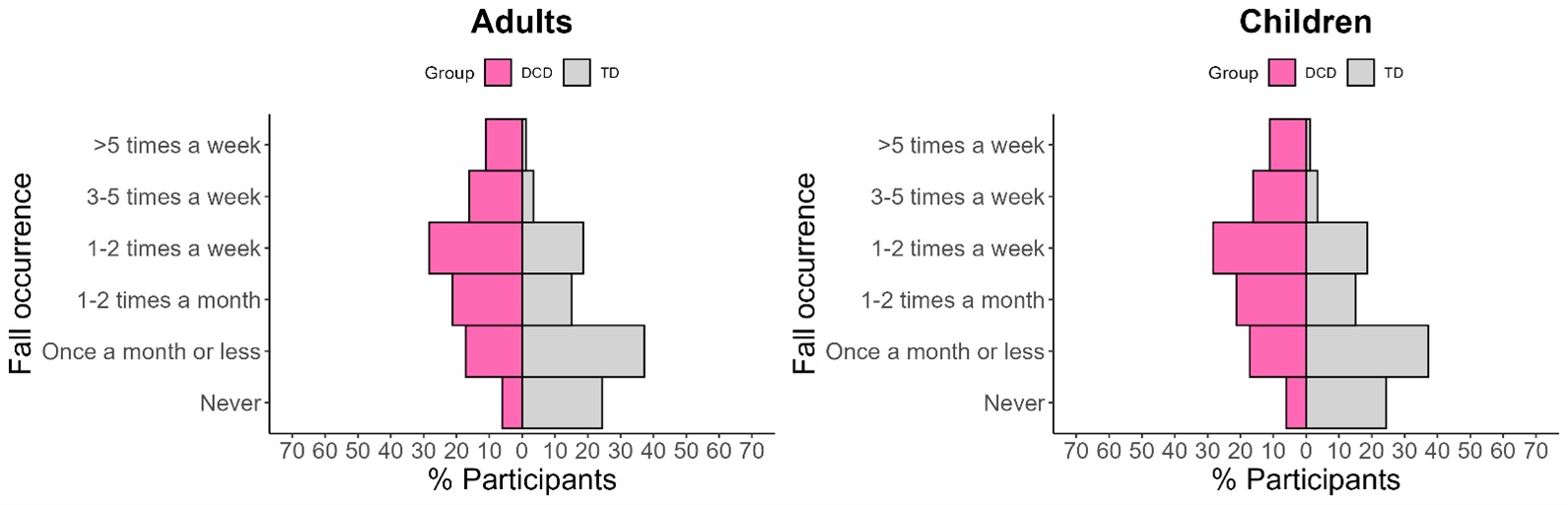
Figure 1. Distribution of self-reported fall frequency in adults and children with and without Developmental Coordination Disorder (DCD). Diverging bar plots show the percentage of participants reporting different fall frequencies for adults (left) and children (right), comparing individuals with DCD (pink) and typically developing (TD; grey) controls. Fall frequency categories range from “Never” to “>5 times a week.”
Parr, J. V., Wood, S., Maw, K., Payne, S., Wright, D. J., Ellmers, T., Mills, R., Marshall, B., Jarvis, C., Mohamed, M. O., & Wood, G. (2026). Developmental Coordination Disorder: A Hidden Epidemic of Falls. Journal of Motor Learning and Development, 14(1), jmld.2025-0043, jmld.2025-0043. https://doi.org/10.1123/jmld.2025-0043
About the Author

Dr Johnny Parr
Senior Lecturer, Manchester Metropolitan University
Dr. Johnny Parr is a cognitive neuroscientist specialising in EEG and the neurophysiology of motor control. His research focuses on understanding Developmental Coordination Disorder (DCD), postural control, and the effects of injury and concussion on brain function. His work aims to inform targeted interventions to improve movement, balance, and rehabilitation outcomes.
Copyright
© 2021 by the author. Except as otherwise noted, the ISPGR blog, including its text and figures, is licensed under a Creative Commons Attribution-ShareAlike 4.0 International License. To view a copy of this license, visit https://creativecommons.org/licenses/by-sa/4.0/legalcode.
ISPGR blog (ISSN 2561-4703)
Are you interested in writing a blog post for the ISPGR website? If so, please email the ISGPR Secretariat with the following information:
- First and Last Name
- Institution/Affiliation
- Paper you will be referencing